
Before ordering a commercial MMA cage, ask the supplier to confirm the usable training area, total installed footprint, installation method and full supply list on a dimensioned drawing. Then compare quotations against that same drawing. A headline cage size and a product photograph are not enough to confirm that the equipment fits your room or that two offers include the same components.
This checklist is for gym owners, equipment distributors and contractors planning an MMA training space. For a sanctioned event, obtain the organizer’s and relevant governing body’s equipment requirements before selecting a model. A product described as “professional” should not be treated as proof of approval for a particular competition.
By EVB | Updated September 14, 2026
Choose the Cage Type Before Comparing Sizes
Start with the training plan. Decide whether the space must support enclosed MMA training, wall-work drills, coaching sessions or a specified event. Also decide whether the equipment will remain installed or must be dismantled between uses.
EVB’s current product pages provide three useful starting points:
| Configuration | Best starting point | Verifiable information on the current EVB page | What still needs project confirmation |
|---|---|---|---|
| Floor MMA cage | EVB Floor MMA Cage | Octagonal floor cage; listed sizes: 4 m, 5 m and 6 m; ground installation without a raised platform; modular bolt connection | Whether the listed size is internal or external, side-to-side or corner-to-corner; complete outer footprint; floor interface; door position; included floor layers |
| Raised-platform cage proposal | EVB Professional MMA Cage | Octagonal cage; listed sizes: 5 × 5 m, 6 × 6 m, 7.3 × 7.3 m, 7.6 × 7.6 m and 9.1 × 9.1 m; page lists a chain-link fence, padded system, floor system and lockable access door | Whether the quoted configuration includes a platform; measurement convention; platform height; steps; complete footprint; exact door and floor details for the proposed model |
| Cage wall panels | EVB MMA Cage Wall Panels | Modular wall-panel system for dividing or configuring training areas; the page describes a steel structure and padded system | Panel quantity and dimensions, support and mounting method, corners, entrances, floor interface and whether the proposed layout is freestanding or fixed |
These public page dimensions are reproduced only as listed. The pages do not clearly state whether they are internal or external measurements, or whether octagonal dimensions run between opposite sides or opposite corners. Do not convert them into room dimensions or treat them as final project specifications. Ask EVB to mark the measurement endpoints on the model-specific drawing.
A wall-panel layout should not be assumed to provide the enclosure, supports, entrance or floor system of a complete cage. Likewise, a professional cage page is not confirmation that a platform, steps or event-specific requirements are included in a quotation.
Plan Internal Training Area and External Footprint Separately
For an octagonal cage, ask the supplier to label all of the following on one drawing:
- usable internal training dimensions;
- whether each octagonal measurement is side-to-side or corner-to-corner;
- total outer frame footprint, including projecting supports or base plates;
- platform height and the footprint of any steps;
- door location, clear opening and opening direction;
- surrounding access, coaching and circulation areas;
- nearby columns, walls, equipment and emergency exits; and
- ceiling height and the delivery route into the room.
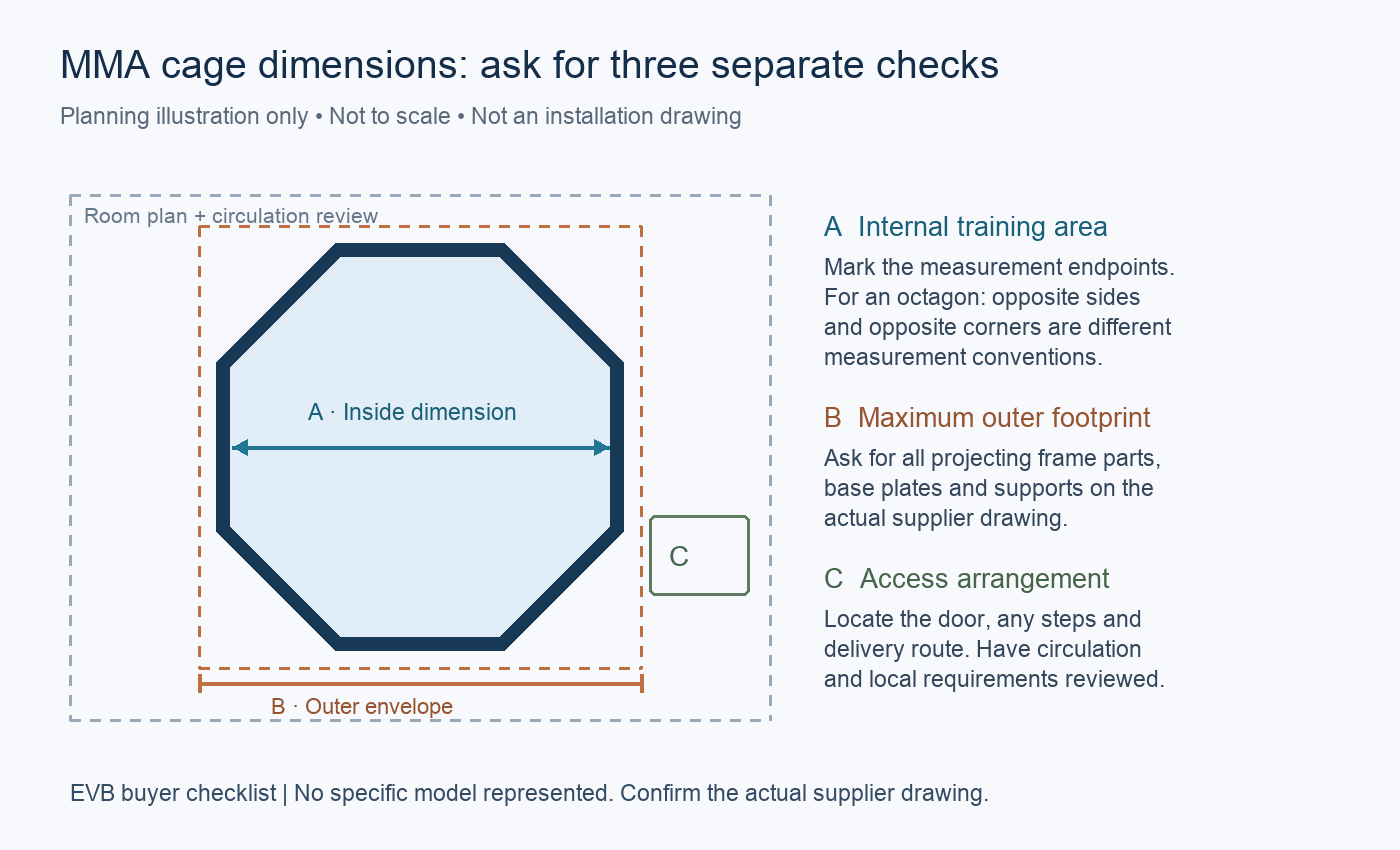
Planning illustration only. Not to scale, not an installation drawing and not a representation of a specific EVB model.
Do not use the internal cage dimension as the required room size. The supplier and installer should review the complete arrangement. Have site-specific structural, building and circulation requirements checked by a qualified local professional.
Also check the delivery route before ordering. Packed frame sections, panels and platform components must pass through the available doors, corridors and lifts. Ask for packed component dimensions rather than assuming that a cage delivered in sections will fit every access route.
What Should an MMA Cage Quote Include?
Send every supplier the same brief and ask for an itemized quotation tied to a drawing revision. Each line should be marked included, optional, excluded or to be confirmed.
- cage frame, fence panels and connection hardware;
- door assembly, hinges, latch or locking hardware;
- padding for the quoted configuration;
- training floor layers and top covering;
- raised platform and platform trim, if required;
- steps, if applicable;
- branding artwork, colors and approved print locations;
- installation drawings and instructions;
- identified spare and replacement parts;
- packing method, package count and packed dimensions;
- freight terms and named destination;
- unloading and movement into the building;
- installation labor and tools;
- written warranty and claim process; and
- production, transit and installation milestones.
“Complete cage” is not a substitute for an itemized supply list. If flooring, freight, unloading, local installation or import charges are excluded, record those costs separately. Leave unresolved costs blank or mark them “to be confirmed”; do not enter zero.
Use the free EVB MMA Cage Procurement Workbook to prepare a project brief, compare quotations side by side and record the documents required before a deposit. It is a blank working document, not a price list.
Keep the production schedule separate from freight, customs clearance and local installation. Ask which milestones depend on drawing approval, artwork approval or payment. A production estimate alone is not an opening-date commitment.
Assign Installation Responsibilities Before Production
Provide a measured floor plan and photographs of the installation area. Include the floor construction if known, any restrictions on drilling, loading access and the route from the delivery point to the room.
Agree in writing who is responsible for:
| Responsibility | Confirmation required |
|---|---|
| Supplier | Model-specific drawing, bill of materials, assembly instructions, connection and padding details, packed dimensions and identified replacement parts |
| Buyer or facility team | Accurate room information, access restrictions, intended use, destination and local site requirements |
| Installer | Labor, tools, assembly sequence, floor preparation and completion checks required by the manufacturer’s instructions |
| Qualified local reviewer | Any site-specific structural, substrate, anchoring, building or circulation requirements |
| Logistics provider | Freight scope, customs responsibility, unloading and final movement into the building |
Where anchoring is required, confirm who specifies and supplies the anchors and who verifies the substrate. Do not choose anchors from a photograph or apply a generic fixing method to an unknown floor.
If the cage will be dismantled regularly, request the model-specific dismantling procedure, packed dimensions, storage requirements, labor and tools. Do not rely on an installation time quoted for a different configuration.
Check Maintenance and Replacement Parts
Before ordering, ask for model-specific documents and close-up images of parts that will need inspection or replacement. A finished-cage photograph is not enough.
- Frame and connections: component identifiers plus inspection and tightening instructions.
- Fence and attachment points: mesh and attachment specification, close-up images of the quoted configuration and the replacement-panel process.
- Door and closing hardware: opening arrangement, operating instructions and replacement hardware identification.
- Padding: coverage shown on the drawing, fixing method, inspection guidance and replacement-pad identification.
- Floor layers and top cover: layer specification, compatibility and fixing instructions, cleaning guidance and replacement-cover identification.
- Base, platform and steps: interfaces, fasteners and inspection points for the quoted configuration.
Ask how to report damage, identify the correct spare part and obtain the manufacturer’s advice on whether the equipment should remain out of use. If a document or replacement arrangement is unavailable, record that gap in the comparison workbook. This checklist does not replace a safety inspection or the manufacturer’s instructions.
Confirm Evidence Before Shipment
Agree before production what evidence can be supplied for the actual order. A useful request can include an overview of the assembled configuration where available, close-up photographs of connections, door hardware and padding, confirmation of approved artwork, and a packing list identifying the components.
If measurements, a video call or an independent inspection are required, put that requirement in the order documents. On arrival, reconcile the shipment with the packing list and record visible transport damage before assembly. Have the installer complete the checks required by the manufacturer’s instructions.
Send a Complete MMA Cage RFQ
For a project-specific quotation, submit the following through EVB’s Get a Quote page:
- buyer type: gym, distributor, contractor or event organizer;
- intended use: enclosed training, wall-work area or specified event;
- requested configuration: floor cage, raised-platform proposal or wall panels;
- desired internal training area and maximum outer footprint;
- measured floor plan, ceiling height and site photographs;
- known floor construction and drilling restrictions;
- cage entrance and surrounding access requirements;
- delivery country, city and postal code;
- unloading arrangements, door openings and lift restrictions;
- required flooring, padding, platform, steps, branding and spare parts;
- order quantity, target opening date and any inspection requirement; and
- event organizer or governing-body requirements, if applicable.
Ask for a model-specific drawing, an itemized supply list and a quotation that identifies inclusions, exclusions and delivery terms. Prices, production timing and installation requirements must be confirmed for the actual project.
MMA Cage Buying FAQs
Is a floor MMA cage the same as a raised-platform cage?
No. A floor cage is installed at ground level without a raised platform. A platform changes the total height, access, steps, floor system, footprint and installation scope. Confirm each item on the proposed model drawing and quotation.
What do EVB’s listed MMA cage sizes measure?
The current floor-cage page lists 4 m, 5 m and 6 m, while the professional-cage page lists 5 × 5 m, 6 × 6 m, 7.3 × 7.3 m, 7.6 × 7.6 m and 9.1 × 9.1 m. Those pages do not clearly define internal versus external measurement or side-to-side versus corner-to-corner measurement. Request a dimensioned drawing with marked endpoints before using a listed size for room planning.
Can wall panels replace a complete MMA cage?
Not automatically. Wall panels can suit wall-work drills or a training-area boundary, but the quoted layout must identify its supports, mounting, padding, corners, entrances and floor interface. Do not assume that a panel package includes the enclosure and floor system of a complete cage.
How much room should I allow around an MMA cage?
There is no single clearance figure in this checklist. Start with the actual outer footprint, door and access arrangement. Then have the supplier, installer and facility team review circulation and applicable local requirements. Internal training dimensions alone do not establish the required room size.
What should I confirm before paying a deposit?
Confirm the dimensioned drawing and revision, itemized component list, customization approvals, payment and delivery terms, installation responsibilities, evidence required before shipment, and written warranty and replacement-part arrangements. Keep unresolved items visible in the order documents rather than in separate chat messages.
Is a professional MMA cage automatically approved for an event?
No. Obtain the organizer’s and relevant governing body’s current requirements for the specific event. Product naming, photographs or a previous installation do not prove approval for another competition or venue.