
When reviewing an assembled ボクシングリング, compare the delivered configuration and shipment contents with the agreed order specification, approved drawings identified in the order documents, packing list, and documented requirements for the intended market or event. Then visually review the accessible frame and check the deck, padding, canvas, ropes, covers, access components, and documents against those records. Photograph each mismatch and record its resolution.
This checklist supports buyer receiving and specification-conformity review; it is not an engineering, structural, regulatory, or event-official approval. The contractually agreed acceptance criteria, applicable rule set, supplied assembly instructions, and designated qualified reviewers remain controlling.
Receiving review covers what arrived and its visible condition. Specification review compares the supplied configuration with the approved order documents. Event or regulatory review belongs to the authority responsible for the named market or event.
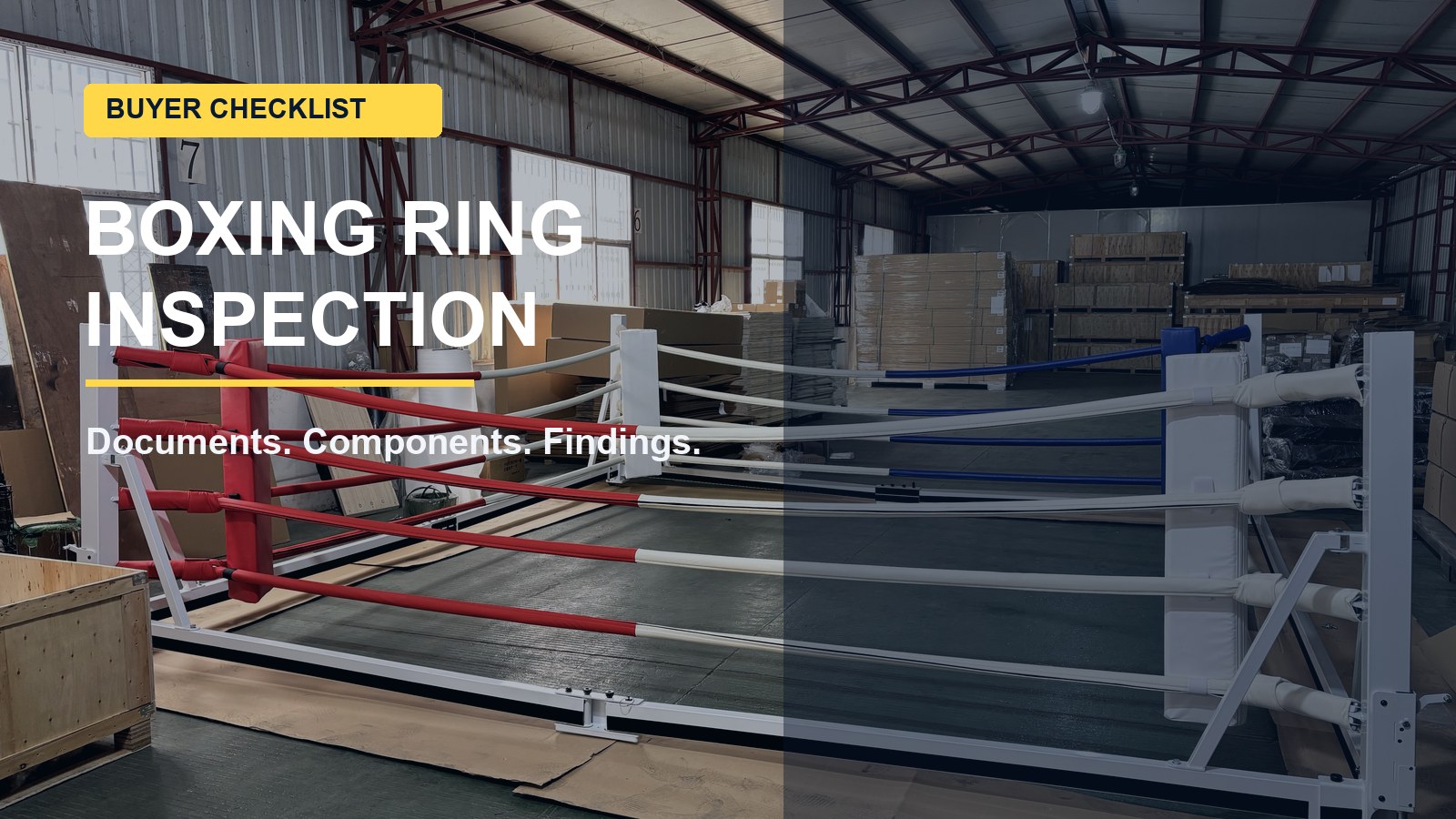
Set the inspection basis before assembly
A useful review starts with the documents that define the order. Put the approved specification, drawings, component list or packing list, branding artwork, assembly instructions, and documented requirements for the intended destination and event in one review pack. If the ring is intended for sanctioned competition, identify the governing body and the exact rule edition instead of using a generic idea of a “regulation ring.”
Rules can serve different roles. For example, if the responsible event authority confirms that the linked World Boxing competition rules and edition (PDF) apply, their relevant provisions become part of the event-configuration review. The cited Virginia regulation provides a separate example of jurisdiction-specific equipment requirements. Treat both as illustrations of why the applicable authority and rule edition must be named—not as universal specifications for every order.
Where the project documents identify competition rules requiring a raised platform, record whether the supplied configuration matches the stated project requirements and refer formal rule compliance to the named event authority. A 折りたたみ式ボクシングリング or another training/event configuration may use a different frame and installation approach, so compare the supplied configuration with its own approved drawing rather than borrowing assumptions from another model.
Buyer-focused inspection checklist
Use simple status labels in the findings log: match, missing, damaged, deviation, technical review required, および closed.
| Phase | Inspection area | What to compare or verify | Evidence to retain |
|---|---|---|---|
| Delivery | Order identity | Model or project reference, finish, colour layout, branding artwork, and supplied configuration match the approved order documents | Overall photos, labels or part references, approved artwork |
| Delivery | Shipment completeness | All components, accessories, hardware, and any tools listed in the approved packing list are present | Packing-list check, shortage log, crate photos |
| Before assembly | Frame condition | Photograph visible transit damage, apparent deformation, visible coating damage, or apparent misalignment on accessible members and joints, then refer the finding for review | Photos before the deck and covers conceal the structure |
| Assembly | Connections | Bolted or pinned connections are in the documented positions with the specified hardware; photograph visible damage, missing hardware, apparent cracks or apparent misalignment and refer the finding for review | Close-up photos and drawing references |
| Assembly | Platform, frame and deck | Component identity and position match approved drawings; photograph visible gaps or apparent misalignment and record measurements only when specified in approved project documents | Wide view, edge details, documented exceptions |
| Final configuration | Padding and canvas | Material, coverage, and thickness match the purchase specification; record folds, ridges, loose areas, moisture or damage | Surface photos and approved material/spec reference |
| Final configuration | Ropes and separators | Compare rope count, covering, height, spacing, and separators with the applicable documents; do not assess rope tension unless those documents provide a checking method and identify who interprets the result | Required measurements and photos of each side |
| Final configuration | Corners and hardware covers | Pads and covers are installed in the documented positions and cover the components identified in the applicable drawing or instructions | Photos of all corners and attachments |
| Final configuration | Branding and finish | Logos, colours, print position, stitching, and visible finish match the approved artwork and any approved sample or reference, where applicable | Artwork comparison and detail photos |
| 設置 | Access and perimeter | Steps or other supplied access components match the approved layout; record any apparent mismatch between the supplied access layout and the documented installation or event layout | Layout measurements and installation photos |
| Records | Documents | Any assembly instructions, component lists, maintenance information, and project-specific records required by the order or contract are present | Document register with version dates |
| Records | Findings | Every mismatch has a responsible party, supporting evidence, and a recorded decision: correct, replace, accept by written concession, or escalate for technical review | Numbered findings log and closure record |
This commercial checklist does not authorise structural or load testing. Where the purchase specification calls for measurements, test records, or technical sign-off, use the method and responsible role identified in the order documents or applicable instructions. Document visible damage or misalignment as an unresolved finding and refer its disposition to the technical or contractual role named in the project documents. This checklist does not determine fitness for use.
When an event rule set applies
After checking the accessible components, compare the assembled configuration with the requirements documented for its particular market and event. A raised-platform プロ仕様のボクシングリング must be reviewed against the authority and rule edition named in its project documents.
Event-official checks serve a different purpose from buyer acceptance. For example, the Association of Boxing Commissions referee manual, revised August 2025 (PDF) describes a referee’s pre-event check of ropes, canvas, post tops, turnbuckles, and corner posts. It should not be used as a purchase specification unless the project documents expressly adopt the relevant requirements.
Competition rules may define an event configuration, a regulator may impose jurisdiction-specific requirements, and an officiating manual may describe operational checks. These sources serve different purposes and apply only when the responsible authority identifies them for the project.
Record findings so they can be resolved
Use a numbered log rather than comments scattered across messages. Each entry should identify the component, the requirement being checked, the observed condition, a photo or measurement, the responsible role or organisation, and the agreed resolution. Separate shortages, cosmetic differences, assembly questions, and items requiring technical review so each can be routed to the role identified in the project process.
For distributors and private-label brands, the findings log can also help make later specifications clearer. Repeated questions about rope layout, branding position, access, or packing can indicate that the next purchase document needs a clearer drawing, tolerance, photo standard, or packing instruction.
Questions to settle before production or shipment
- Which destination market, event type, governing body, and rule edition will the ring be specified against?
- Which approved drawing and revision define the supplied configuration?
- Which components and accessories are included in the packing list?
- Which measurements or records must accompany the order?
- Are the supplied assembly instructions complete for this configuration, and who should answer unresolved questions?
- How will shortages, damage, drawing deviations, and artwork differences be documented and resolved under the contract?
Frequently asked questions
Is there one rule set for every boxing ring project?
Do not assume that one rule set governs every destination or event. The buyer should identify the authority and rule edition for the particular project, then compare the supplied configuration with the resulting project requirements.
How should a buyer review accessible frame connections?
During a buyer receiving review, visually survey the accessible structure before the deck, padding, and covers hide it without treating that review as structural approval. Confirm component location and hardware against the approved drawings, and document visible damage, missing hardware, apparent cracks, or apparent misalignment. Refer potential structural concerns for qualified technical review.
How tight should boxing ring ropes be?
Do not assess rope tension unless the rule set or project documents provide a checking method and identify who interprets the result. Different authorities may describe rope tension differently, so do not copy one event’s instruction into another project without confirming that it governs the intended use.
What evidence should be kept after inspection?
Keep the document revision used for the check, overall and detail photos, measured exceptions, a shortage list, and a numbered findings log. Link each finding to its requirement and record the agreed resolution so dealers, brand teams, installers, and suppliers are working from the same record.
What should happen when the delivered ring does not match the specification?
Record the mismatch, classify it as a shortage, cosmetic difference, assembly question, specification deviation, or item requiring technical review, and route it under the contract. Refer any technical question to the role named in the project process and close the finding only through that documented process.
Discuss your boxing ring project
Use EVB’s project inquiry form to share the destination market, intended event or use, governing rule set, required dimensions and any available or approved drawings, installation layout, branding files, required configuration, and target delivery location. You can also compare the boxing-ring range before submitting the brief. These details help EVB understand the requested configuration and discuss the project requirements with you.