
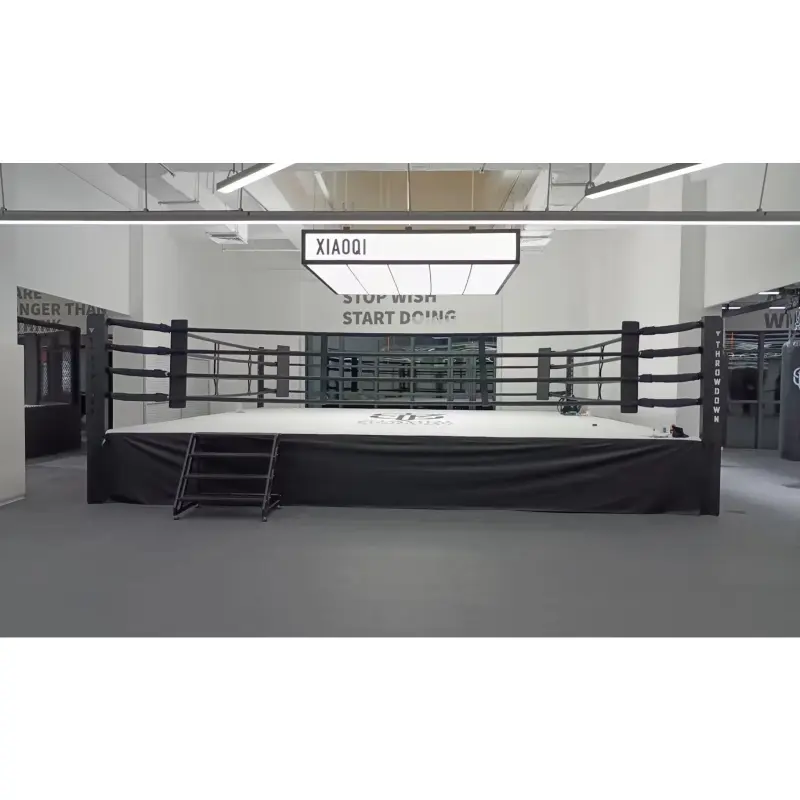
In the world of combat sports, the “squared circle” is much more than a stage; it is a precisely engineered environment where every inch can dictate the outcome of a fight. While most fans focus on the athletes, the standard dimensions of a professional boxing ring play a critical role in how a bout unfolds.
Whether you are a gym owner, a curious fan, or a budding boxer, understanding these specifications is essential to grasping the strategic depth of the sport.
Standard Professional Boxing Ring Dimensions
Contrary to what many believe, there isn’t a single universal size for every professional fight. However, most major athletic commissions and sanctioning bodies have established a range that is considered “regulation.”
Typically, a professional boxing ring measures between 16 and 24 feet (4.9 to 7.3 meters) on each side between the ropes. The most common size used for high-level televised matches is 20 feet (6.1 meters).
Regulatory Differences: WBC, WBA, WBO, and IBF
Different sanctioning bodies have slightly varying requirements. This can sometimes lead to pre-fight negotiations where a “puncher” might argue for a smaller ring, while a “mover” wants more space.
- WBC (World Boxing Council): Generally requires a ring between 18 and 24 feet inside the ropes.
- WBA & WBO (World Boxing Association/Organization): Usually mandate a minimum of 18 feet and a maximum of 22 feet.
- IBF (International Boxing Federation): Typically adheres to a 16 to 20-foot standard.
Anatomy of a Regulation Ring: Beyond the Square
The size of the fighting area is only one part of the equation. To meet professional safety and broadcast standards, several other components must be strictly measured.
The Canvas and Padding
The “canvas” isn’t just a sheet. It sits atop a layer of high-density foam or “ensolite” padding that must be at least 1 inch thick. This padding absorbs the impact of falls and protects fighters’ joints during intense footwork. The top layer is a heavy-duty cotton duck canvas or vinyl, tightly stretched to prevent dangerous bunching or slipping.
The Ropes and Corner Posts
Modern professional rings must have four ropes. These are roughly 1 inch in diameter and are spaced at specific intervals from the floor to prevent fighters from slipping through.
- Bottom Rope: 18 inches above the floor.
- Top Rope: 54 inches above the floor.
- The middle ropes are spaced at 30 and 42 inches respectively.
The corner posts are made of heavy-duty metal (at least 3 inches in diameter) and must be padded with protective cushions to prevent injury during clinches or knockdowns.
The Apron and Platform Height
The platform itself is usually raised 3 to 4 feet off the ground to provide the best sightlines for judges and the live audience. Beyond the ropes, there is an “apron”—an extension of the floor—that must be at least 18 to 24 inches wide. This provides a safety buffer for boxers who might be pushed near the edge.
Professional vs. Olympic Ring Sizes
In the amateur and Olympic ranks, consistency is prioritized over promoter preference. The International Boxing Association (IBA) standardizes the ring for international competitions at 6.10 meters (approximately 20 feet) square inside the ropes.
While some lower-level amateur tournaments may use rings as small as 16 feet to encourage action, the Olympic standard is designed to be the “golden mean”—providing enough space for technical movement without sacrificing the proximity required for high-scoring exchanges.
Why Ring Size Changes the Fight Strategy
In boxing, space is a weapon. The dimensions of the ring can fundamentally change the “physics” of the match:
- Small Rings (16–18 ft): These favor “sluggers” and pressure fighters. With less room to retreat, defensive “out-boxers” find themselves trapped against the ropes more often, forcing them into high-risk trades.
- Large Rings (22–24 ft): These favor technical movers and “stick-and-move” specialists. Boxers with elite cardio and footwork can use the extra space to stay out of range, frustrating power punchers who struggle to “cut off the ring.”
Conclusion
While the term “boxing ring” sounds simple, the standard dimensions of a professional boxing ring are a complex blend of safety regulations and tactical variables. From the 1-inch padding to the 20-foot square standard, every measurement exists to balance the safety of the fighter with the entertainment of the fans.
 English
  Français
  Deutsch
  Español
  Português
  日本語
日本語  Nederlands
  Svenska
  العربية
  Italiano