
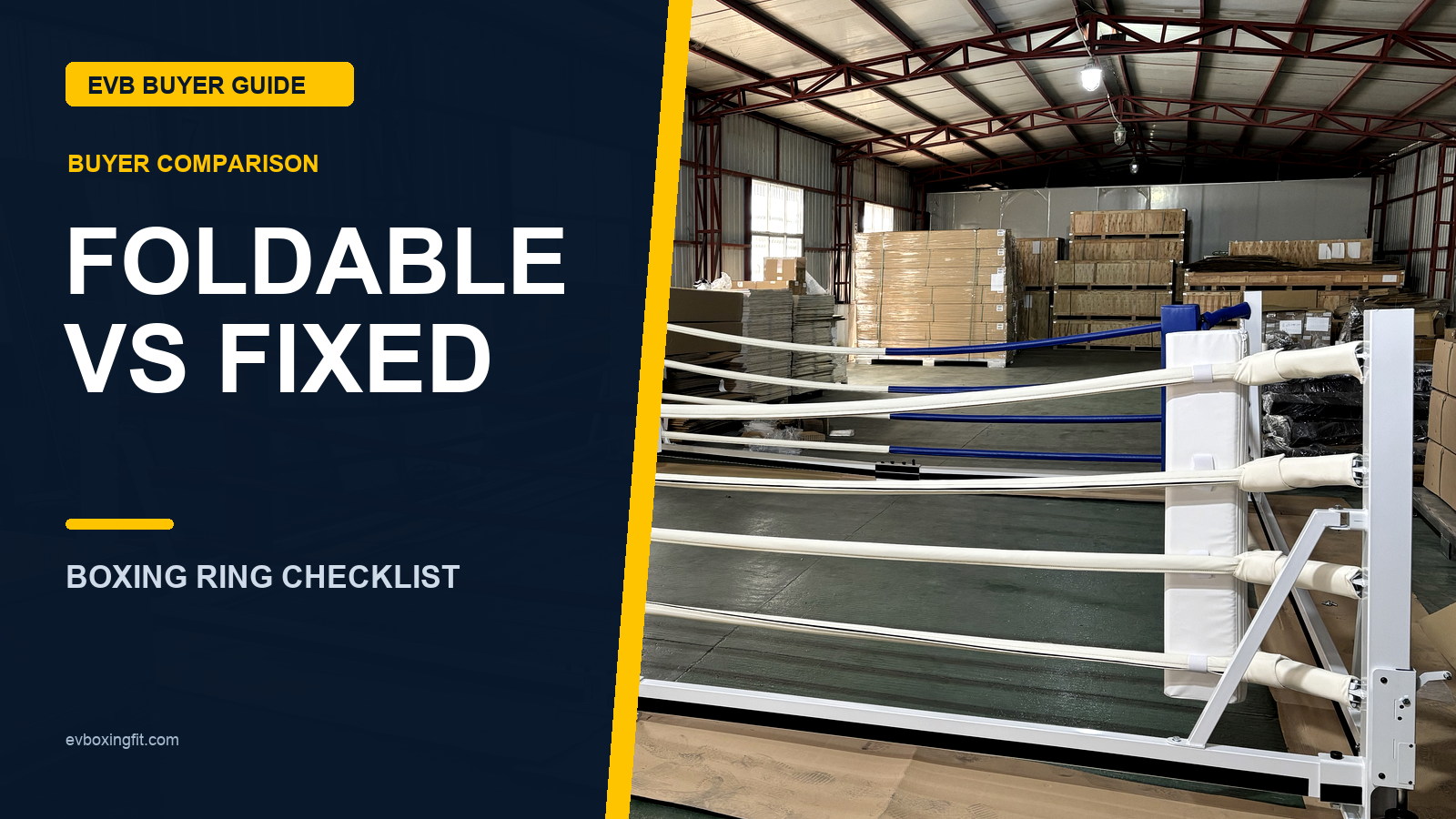
Short answer: choose a foldable boxing ring when the end-use space must change between activities; choose a fixed ring when the ring will stay assembled in a dedicated layout. The right comparison is not simply “portable versus permanent.” Buyers should compare the complete footprint, handling method, supplied components, installation interface and operating routine for the exact model.
This guide is for distributors, combat-equipment brands and retailers comparing ring formats for a catalog or customer project. It keeps the commercial product page focused on the ring de boxe pliable, while this page answers the format-selection question.
Foldable vs fixed boxing ring: quick comparison
| Decision point | Bague pliable | Fixed ring | What to confirm |
|---|---|---|---|
| Room use | Designed for layouts that may need to change | Designed to remain assembled in a defined area | Open and stored layout for the selected model |
| Handling | Folding, moving and storage form part of the operating routine | Routine movement is usually not the purchasing priority | Who moves it, how it moves and where it is stored |
| Site planning | Both operating and stored positions matter | The installed footprint and surrounding access matter | Usable area, maximum footprint, access route and ceiling clearance |
| Installation | Confirm setup sequence and any locking or support points | Confirm the floor or platform interface and assembly plan | Responsibilities, tools, anchoring and site preparation |
| Quotation | Must state the folding system and handling-related components | Must state the ring structure and installed components | One written scope that allows like-for-like comparison |
Start with the end-use layout
A format decision should begin with a measured layout, not a product name. Ask the customer or project team to mark the intended ring position, surrounding circulation, delivery route and the space available when the ring is not in use.
For a foldable ring, request both the operating arrangement and the stored arrangement for the exact model. For a fixed ring, request the complete installed footprint rather than relying only on the usable ring area. In both cases, check doors, stairs, lifts, turning points and any site restrictions that affect delivery or assembly.
Define what “fixed” means in the quotation
In this comparison, “fixed” means a ring intended to remain assembled in one layout. It does not by itself specify whether the ring is floor-level or raised-platform. Those are separate configuration questions. If a raised-platform ring is required, record the requested platform height and confirm it on the model-specific drawing.
Le boxing ring range explains the difference between floor, raised-platform and foldable formats. Use that category view to choose the format; use a model page and drawing to confirm the actual product.
Questions to ask before choosing a foldable ring
- What are the open and stored dimensions of the selected model?
- Which components fold, detach or remain assembled?
- How is the structure secured in its operating position?
- How many people and what equipment are expected for normal handling?
- Where will the ring be stored, and is the access route suitable?
- Which protective covers, carts, tools or other handling items are included, optional or excluded?
- What inspection should be performed after each setup or movement?
Do not assume that every product sold as “foldable” follows the same method. The mechanism, movement procedure and supply scope need to be checked model by model.
Questions to ask before choosing a fixed ring
- Is the project floor-level or raised-platform?
- What are the usable area and maximum outer footprint?
- What floor preparation, fixing method or platform interface is required?
- What access space is needed around the installed ring?
- Which parts are included in the quoted supply scope?
- Who is responsible for unloading, assembly and final site checks?
- How will replacement wear parts be identified for later orders?
Compare quotations on the same basis
A low headline price is not comparable when one quotation includes the complete ring system and another excludes key components, delivery responsibilities or installation-related items. Ask each supplier to answer the same written brief.
- Ring format and intended use
- Usable area and maximum outer footprint
- Floor-level or raised-platform requirement
- Open and stored dimensions where applicable
- Included, optional and excluded components
- Packaging units and packed dimensions to confirm
- Site preparation and installation responsibilities
- Brand artwork locations and approval process
- Inspection documents and replacement-parts identification
Use an inspection plan for either format
The format changes what needs attention, but it does not remove the need for inspection. A foldable system adds handling and repeated setup points to the routine. A fixed ring still needs checks of ropes, padding, covers, connections and the surrounding area. Use the boxing ring inspection checklist as a starting framework, then adapt it to the selected model and the end user’s procedures.
Which option is better for a product range?
There is no universal winner. A distributor may carry one format as the core offer and use the other for projects with different space requirements. A retailer or smaller brand team may be better served by a narrow, clearly explained offer than by listing multiple rings without drawings, scope definitions or handling information.
Choose the format you can explain and quote accurately. The product listing should state the intended use, information available before order and the details that require project confirmation.
Information to send for a ring recommendation
Send the destination market, buyer type, intended use, available floor area, ceiling clearance, delivery access, preferred ring format, requested quantities and any branding references. For a project order, add a measured site sketch. For a catalog item, explain the customer segment and the information your sales team needs for resale.
Discuss your boxing ring brief with EVB.
Frequently asked questions
Is a foldable boxing ring always the smaller option?
No. “Foldable” describes the structure’s handling concept, not a universal size. Compare the open dimensions, stored dimensions and complete footprint of the exact model.
Does a fixed boxing ring always mean a raised-platform ring?
No. Fixed describes the intended installation pattern. Floor-level and raised-platform are separate configuration choices that should be written into the brief.
Should branding be decided before the structure?
No. Confirm the ring format, layout, components and quotation basis first. Then review artwork positions against the selected model.
Can one quotation be compared directly with another?
Only when both use the same dimensions, supply scope, installation responsibilities and packaging basis. Normalize those fields before comparing price.